


Page 4 - Demo
P. 4
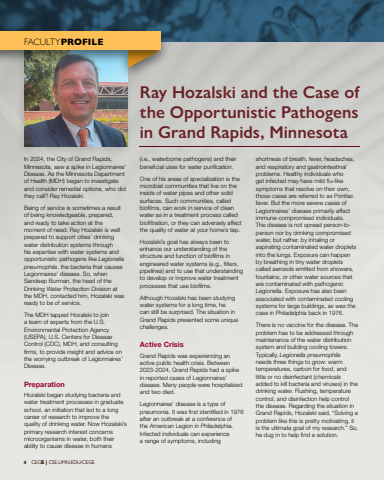
4 CEGE | CSE.UMN.EDU/CEGE In 2024, the City of Grand Rapids, Minnesota, saw a spike in Legionnaires%u2019 Disease. As the Minnesota Department of Health (MDH) began to investigate and consider remedial options, who did they call? Ray Hozalski. Being of service is sometimes a result of being knowledgeable, prepared, and ready to take action at the moment of need. Ray Hozalski is well prepared to support cities%u2019 drinking water distribution systems through his expertise with water systems and opportunistic pathogens like Legionella pneumophila, the bacteria that causes Legionnaires%u2019 disease. So, when Sandeep Burman, the head of the Drinking Water Protection Division at the MDH, contacted him, Hozalski was ready to be of service. The MDH tapped Hozalski to join a team of experts from the U.S. Environmental Protection Agency (USEPA), U.S. Centers for Disease Control (CDC), MDH, and consulting firms, to provide insight and advice on the worrying outbreak of Legionnaires%u2019 Disease. PreparationHozalski began studying bacteria and water treatment processes in graduate school, an initiation that led to a long career of research to improve the quality of drinking water. Now Hozalski%u2019s primary research interest concerns microorganisms in water, both their ability to cause disease in humans (i.e., waterborne pathogens) and their beneficial uses for water purification. One of his areas of specialization is the microbial communities that live on the inside of water pipes and other solid surfaces. Such communities, called biofilms, can work in service of clean water as in a treatment process called biofiltration, or they can adversely affect the quality of water at your home%u2019s tap.Hozalski%u2019s goal has always been to enhance our understanding of the structure and function of biofilms in engineered water systems (e.g., filters, pipelines) and to use that understanding to develop or improve water treatment processes that use biofilms. Although Hozalski has been studying water systems for a long time, he can still be surprised. The situation in Grand Rapids presented some unique challenges.Active CrisisGrand Rapids was experiencing an active public health crisis. Between 2023-2024, Grand Rapids had a spike in reported cases of Legionnaires%u2019 disease. Many people were hospitalized and two died. Legionnaires%u2019 disease is a type of pneumonia. It was first identified in 1976 after an outbreak at a conference of the American Legion in Philadelphia. Infected individuals can experience a range of symptoms, including shortness of breath, fever, headaches, and respiratory and gastrointestinal problems. Healthy individuals who get infected may have mild flu-like symptoms that resolve on their own, those cases are referred to as Pontiac fever. But the more severe cases of Legionnaires%u2019 disease primarily affect immune-compromised individuals. The disease is not spread person-toperson nor by drinking compromised water, but rather, by inhaling or aspirating contaminated water droplets into the lungs. Exposure can happen by breathing in tiny water droplets called aerosols emitted from showers, fountains, or other water sources that are contaminated with pathogenic Legionella. Exposure has also been associated with contaminated cooling systems for large buildings, as was the case in Philadelphia back in 1976. There is no vaccine for the disease. The problem has to be addressed through maintenance of the water distribution system and building cooling towers. Typically, Legionella pneumophilaneeds three things to gro warm temperatures, carbon for food, and little or no disinfectant (chemicals added to kill bacteria and viruses) in the drinking water. Flushing, temperature control, and disinfection help control the disease. Regarding the situation in Grand Rapids, Hozalski said, %u201cSolving a problem like this is pretty motivating, it is the ultimate goal of my research.%u201d So, he dug in to help find a solution.Ray Hozalski and the Case of the Opportunistic Pathogens in Grand Rapids, MinnesotaFACULTYPROFILE


