


Page 9 - Demo
P. 9
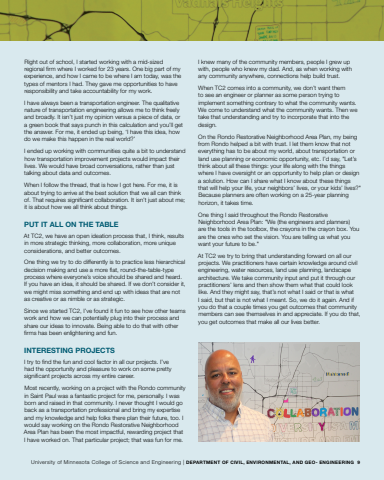
Right out of school, I started working with a mid-sized regional firm where I worked for 23 years. One big part of my experience, and how I came to be where I am today, was the types of mentors I had. They gave me opportunities to have responsibility and take accountability for my work. I have always been a transportation engineer. The qualitative nature of transportation engineering allows me to think freely and broadly. It isn%u2019t just my opinion versus a piece of data, or a green book that says punch in this calculation and you%u2019ll get the answer. For me, it ended up being, %u2018I have this idea, how do we make this happen in the real world?%u2019 I ended up working with communities quite a bit to understand how transportation improvement projects would impact their lives. We would have broad conversations, rather than just talking about data and outcomes.When I follow the thread, that is how I got here. For me, it is about trying to arrive at the best solution that we all can think of. That requires significant collaboration. It isn%u2019t just about me; it is about how we all think about things. PUT IT ALL ON THE TABLEAt TC2, we have an open ideation process that, I think, results in more strategic thinking, more collaboration, more unique considerations, and better outcomes. One thing we try to do differently is to practice less hierarchical decision making and use a more flat, round-the-table-type process where everyone%u2019s voice should be shared and heard. If you have an idea, it should be shared. If we don%u2019t consider it, we might miss something and end up with ideas that are not as creative or as nimble or as strategic. Since we started TC2, I%u2019ve found it fun to see how other teams work and how we can potentially plug into their process and share our ideas to innovate. Being able to do that with other firms has been enlightening and fun.INTERESTING PROJECTSI try to find the fun and cool factor in all our projects. I%u2019ve had the opportunity and pleasure to work on some pretty significant projects across my entire career. Most recently, working on a project with the Rondo community in Saint Paul was a fantastic project for me, personally. I was born and raised in that community. I never thought I would go back as a transportation professional and bring my expertise and my knowledge and help folks there plan their future, too. I would say working on the Rondo Restorative Neighborhood Area Plan has been the most impactful, rewarding project that I have worked on. That particular project; that was fun for me.I knew many of the community members, people I grew up with, people who knew my dad. And, as when working with any community anywhere, connections help build trust. When TC2 comes into a community, we don%u2019t want them to see an engineer or planner as some person trying to implement something contrary to what the community wants. We come to understand what the community wants. Then we take that understanding and try to incorporate that into the design. On the Rondo Restorative Neighborhood Area Plan, my being from Rondo helped a bit with trust. I let them know that not everything has to be about my world, about transportation or land use planning or economic opportunity, etc. I%u2019d say, \think about all these things: your life along with the things where I have oversight or an opportunity to help plan or design a solution. How can I share what I know about these things that will help your life, your neighbors%u2019 lives, or your kids%u2019 lives?\Because planners are often working on a 25-year planning horizon, it takes time. One thing I said throughout the Rondo Restorative Neighborhood Area Plan: \are the tools in the toolbox, the crayons in the crayon box. You are the ones who set the vision. You are telling us what you want your future to be.\At TC2 we try to bring that understanding forward on all our projects. We practitioners have certain knowledge around civil engineering, water resources, land use planning, landscape architecture. We take community input and put it through our practitioners%u2019 lens and then show them what that could look like. And they might say, that%u2019s not what I said or that is what I said, but that is not what I meant. So, we do it again. And if you do that a couple times you get outcomes that community members can see themselves in and appreciate. If you do that, you get outcomes that make all our lives better.University of Minnesota College of Science and Engineering | DEPARTMENT OF CIVIL, ENVIRONMENTAL, AND GEO- ENGINEERING 9


